A professional website is more than an online address for a business. It is often the first place where potential customers learn about a company, evaluate its credibility, understand its services, and decide whether to make contact. This makes the quality, functionality, speed, and usability of a website important parts of a digital business strategy.
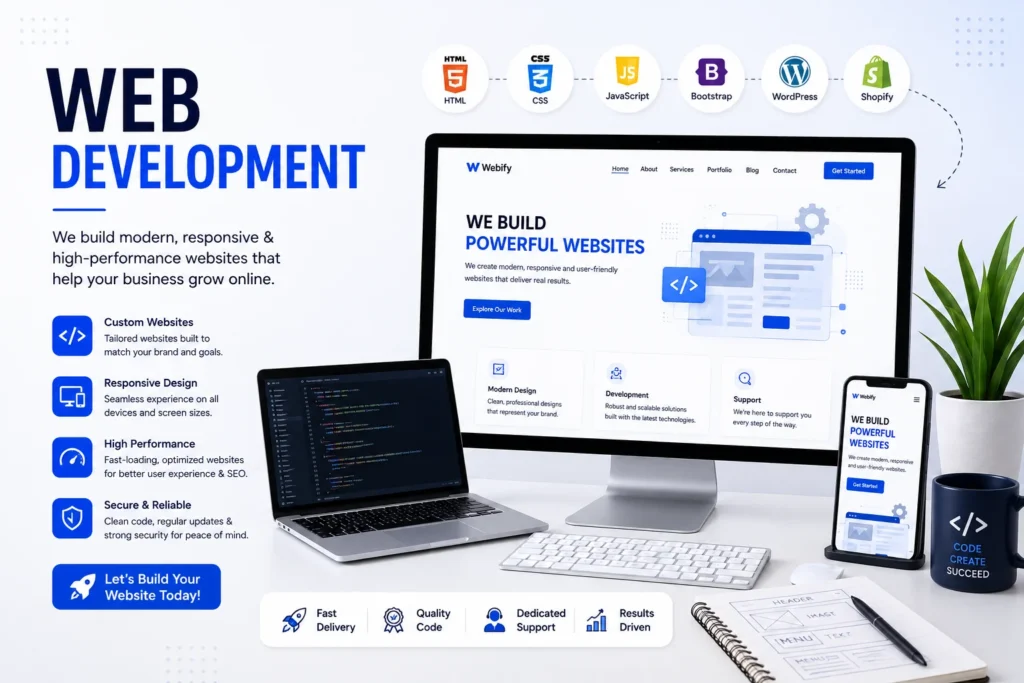
Web development services cover the planning, development, testing, maintenance, and improvement of websites and web applications. Depending on business requirements, development may involve front-end interfaces, back-end systems, databases, content management systems, e-commerce functionality, integrations, security, and performance optimization.
For businesses that want a website capable of supporting marketing, customer communication, lead generation, online sales, or long-term growth, choosing the right development approach is important. A website should not only look professional but also provide a smooth experience across devices and support the business objectives behind it.
Google also recommends creating helpful, reliable, people-first content and using language that matches the way users search for information.
What Do Web Development Services Include?
Web development services can include everything required to create and maintain a functional website. The exact scope depends on the type of website, business goals, technology requirements, and expected users.
Common development services include:
- Business website development
- Custom website development
- E-commerce development
- WordPress development
- Front-end development
- Back-end development
- Web application development
- Database integration
- API integration
- Content management system development
- Website maintenance
- Website security improvements
- Website performance optimization
- Responsive website development
A simple business website may require a different technical structure than an e-commerce platform or a web-based application. Therefore, development should begin with an understanding of the website’s purpose rather than selecting technologies without considering business requirements.
Why Are Web Development Services Important for a Business?
A website represents a business online and can influence how visitors interact with its products, services, content, and brand.
Well-planned web development services can help create a website that is:
- Easy to navigate
- Responsive on mobile devices
- Structured around user needs
- Fast and technically accessible
- Secure and maintainable
- Suitable for search visibility
- Scalable as business requirements change
A website can also work as part of a broader digital marketing strategy. SEO, content marketing, social media marketing, paid advertising, and email campaigns often direct users toward website pages. If those pages are difficult to use or fail to communicate the intended message, marketing efforts may become less effective.
Good development therefore provides the technical foundation on which other digital activities can operate.
How Do Web Development Services Improve User Experience?
User experience is closely connected to how visitors interact with a website. Navigation, page structure, buttons, forms, readability, mobile usability, and loading performance can all influence whether users continue browsing.
Professional web development services can address these areas during the development process.
For example, developers can structure navigation so important pages are easy to find. Forms can be designed with clear fields and useful validation. Responsive layouts can help pages adapt to different screen sizes. Interactive elements can be developed to behave consistently across supported devices and browsers.
The goal should not be to add unnecessary design elements. Instead, every feature should have a purpose that supports the visitor or the business.
What Is the Difference Between Front-End and Back-End Development?
Front-end development focuses on the part of a website that users see and interact with. It can include page layouts, navigation, buttons, forms, menus, visual components, and responsive behavior.
Back-end development works behind the interface. It can involve servers, databases, authentication, business logic, APIs, data processing, and other functions that support website operations.
For many projects, both areas work together.
For example, consider an online store. The front end allows customers to browse products, add items to a cart, and submit an order. The back end can process product information, customer accounts, inventory data, orders, and payment-related integrations.
A complete development strategy considers both sides so the website provides a consistent experience while its underlying systems operate reliably.
Which Web Development Services Are Suitable for Small Businesses?
Small businesses do not always require complex web applications. In many cases, a professionally developed business website with clear service pages, contact options, responsive design, and a manageable content system may be sufficient.
The right web development services depend on factors such as:
- Business objectives
- Target audience
- Number of website pages
- Required functionality
- Content management requirements
- E-commerce needs
- Third-party integrations
- Future expansion plans
- Maintenance requirements
- Available budget
A smaller website should still have a strong technical foundation. Choosing a scalable structure can make future improvements easier if the business adds services, products, content, integrations, or other functionality.
How Do Web Development Services Support SEO?
SEO is not limited to keywords and written content. The technical structure of a website can influence how search engines access, understand, and display its pages.
Effective web development services can support SEO by creating logical page structures, responsive layouts, accessible navigation, clean internal linking opportunities, appropriate metadata implementation, and technically sound pages.
Google’s Search Essentials specifically highlights making content accessible and using words that users search for in relevant prominent locations, while technical requirements help Google crawl and understand web pages.
Development should therefore work alongside SEO rather than treating SEO as a completely separate activity.
For example, developers and SEO professionals may need to coordinate on:
- URL structures
- Website hierarchy
- Internal linking
- Mobile usability
- Page performance
- Indexability
- Structured data implementation
- Redirects
- Canonicalization
- Image handling
- Technical accessibility
This collaboration can create a stronger foundation for organic search visibility.
Why Is Responsive Design Important in Web Development Services?
People access websites from desktops, laptops, tablets, and smartphones. A website that works properly on only one screen size can create usability problems for visitors using other devices.
Responsive development allows page layouts and elements to adapt to different screen dimensions.
This can include:
- Flexible layouts
- Responsive images
- Mobile-friendly navigation
- Touch-friendly interface elements
- Readable typography
- Appropriate spacing
- Device-compatible functionality
Responsive design should be considered during development rather than added as an afterthought. Testing across different screen sizes and browsers can also help identify usability problems before or after launch.
How Do Web Development Services Improve Website Performance?
Website performance affects how quickly visitors can access and interact with pages. Large images, unnecessary scripts, inefficient code, excessive third-party resources, and poorly configured servers can contribute to slower experiences.
Development teams can review technical elements such as:
- Image sizes and formats
- JavaScript and CSS resources
- Server response behavior
- Browser caching
- Code efficiency
- Content delivery
- Third-party scripts
- Database queries
Performance work should be based on actual technical findings rather than adding optimization techniques without understanding the underlying issue.
A faster website does not automatically guarantee higher rankings or conversions, but performance contributes to the overall quality of the user experience and should form part of a broader website strategy.
What Should Businesses Consider Before Choosing Web Development Services?
Before selecting a development provider, businesses should clearly define what the website needs to accomplish.
Important questions include:
What is the primary purpose of the website?
A website may focus on lead generation, online sales, brand information, customer support, bookings, publishing, or a combination of objectives.
What functionality is required?
The project may require forms, payment systems, user accounts, booking systems, product catalogs, APIs, dashboards, or other functionality.
Who will manage the website after launch?
Businesses should consider whether internal employees need access to update pages, products, images, or other content.
How will the website be maintained?
Security updates, backups, performance monitoring, content changes, and technical maintenance can be important after launch.
Can the website scale?
A website should ideally accommodate future requirements without requiring a complete rebuild for every major change.
Clear answers to these questions can help businesses select a development approach that aligns with their actual requirements.
How Can Web Development Services Support Business Growth?
A website can become an important part of a company’s digital infrastructure. As a business grows, its website may need additional pages, services, products, integrations, content, forms, or customer-facing functionality.
Scalable web development services can make it easier to introduce these changes while maintaining a consistent technical structure.
For example, a business may initially launch with a small service website and later add:
- Blog functionality
- Lead-generation forms
- Customer portals
- E-commerce features
- Online booking
- Marketing integrations
- Analytics
- CRM integrations
- Additional service categories
Planning for future requirements can reduce the need for disruptive redevelopment.
What Makes a Professional Website Development Process Effective?
A structured development process helps reduce technical problems and keeps the project aligned with its objectives.
A typical process can include:
1. Requirement Analysis
The development team identifies business objectives, target users, required functionality, content requirements, integrations, and technical constraints.
2. Website Planning
The team develops the website structure, page hierarchy, navigation, functionality requirements, and technical approach.
3. Design and User Experience
Page layouts and interface components are planned around usability, branding, content, and conversion objectives.
4. Development
Developers build the front-end and back-end components according to the approved requirements.
5. Testing
The website is tested for functionality, responsiveness, browser compatibility, forms, links, performance, and other technical requirements.
6. Launch
After testing and final checks, the website is deployed to its production environment.
7. Maintenance
Ongoing maintenance can address security, content changes, technical issues, performance improvements, and future functionality.
This structured approach helps ensure that development is not limited to visual design but considers the complete website lifecycle.
How Should Businesses Measure Website Development Success?
Website success should be measured against the original business objectives rather than relying on a single metric.
Depending on the website’s purpose, useful measurements may include:
- Organic search traffic
- Qualified leads
- Contact form submissions
- Sales or transactions
- Conversion rates
- Engagement metrics
- Returning visitors
- Page performance
- Mobile usability
- Website uptime
- User behavior
The appropriate metrics depend on what the website is designed to accomplish.
A lead-generation website may focus heavily on qualified inquiries, while an e-commerce website may prioritize transactions and revenue. A content-focused website may pay closer attention to organic visibility and engaged readership.
Conclusion
Web development services provide the technical foundation for a modern business website. From front-end interfaces and responsive design to back-end functionality, integrations, security, performance, and maintenance, development affects how effectively a website serves both users and business objectives.
A successful website should combine usability, technical quality, clear information architecture, responsive functionality, and a structure that can support future requirements. Development should also work alongside SEO and content strategies so that the website is useful for visitors and accessible to search engines.
For businesses planning a new website or improving an existing one, the most important starting point is to define the site’s purpose, audience, functionality, and long-term requirements. Genzy Link Pro provides web development services focused on creating responsive, user-friendly, SEO-friendly, and scalable websites that support digital marketing and business growth. A development approach built around specific business needs can provide a stronger foundation for customer engagement and long-term online growth.
FAQs
Web development services involve the planning, building, testing, launching, and maintenance of websites and web applications. They can include front-end development, back-end development, databases, integrations, content management systems, e-commerce functionality, security, and performance optimization.
Businesses need web development services to create websites that are functional, responsive, secure, maintainable, and aligned with their business objectives. A professionally developed website can support marketing, lead generation, online sales, customer communication, and brand visibility.
Yes. Website development can support SEO through a logical site structure, responsive design, accessible navigation, technically sound pages, appropriate URLs, performance improvements, and other technical elements. SEO and development should work together rather than being treated as completely separate processes.
Yes. E-commerce development can include product catalogs, shopping carts, checkout functionality, payment integrations, customer accounts, order management, inventory features, and other functionality required by an online store.
Development time depends on the project’s scope and complexity. A smaller business website may require less time, while websites involving custom functionality, databases, integrations, e-commerce, or complex applications can require a longer development process.